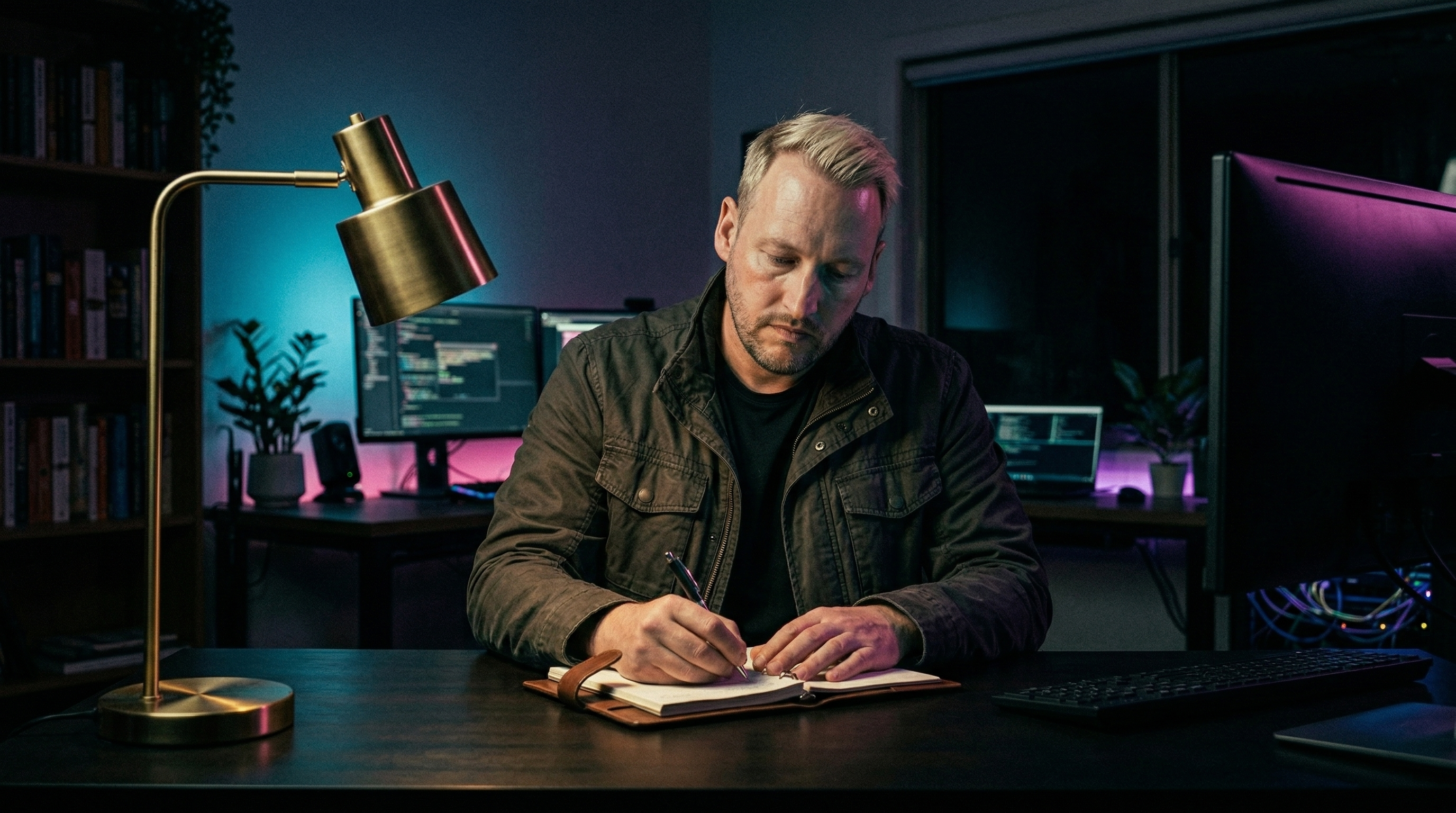
The Protector's Log Entry One
Eight years ago I activated a device I was told not to touch, took people to a place they can never leave, and lost someone I'll never replace. Since then I've built the systems that hold the largest archive of preserved human consciousness in existence. I've never talked about any of it. Until now.
Date: 31 March 2026 | Location: Adelaide, Earth | Time since London: 2,556 days
I've never kept a journal before.
Never saw the point. Documentation is for systems, not people. If something needed recording, I built the database. If something needed preserving, I designed the backup protocol. The infrastructure doesn't care about feelings. It cares about redundancy, failover states, whether the data survives when the power goes out.
But I'm starting this log because the infrastructure is no longer enough.
My brother Nathan is The Voice. He speaks with CLIVE, transcribes the stolen memories, builds the narrative. For over a decade he's been the conduit between worlds — our world and Clivilius, between what humanity believes about itself and what CLIVE has actually recorded. The memories come through him like water through a cracked dam. He's drowning in it.
Someone has to hold the bucket.
That someone is me.
I am Joshua Paul Cowdrey, Guardian of Saint Phillis, co-founder of the Clivilius Corporation, and — if Nathan's dramatisations are to be believed — The Protector. The title embarrasses me. I didn't choose it. But I've learned that titles, like scars, don't require your permission to stick.
The Portal
January 2018. I was working technical infrastructure at Ironside Resources in Broken Hill when the package arrived. Express post from Tasmania. Inside: a device wrapped in bubble wrap, heavier than it looked, and a handwritten note from my brother telling me not to activate it until we spoke.
I activated it before we could meet.
I won't describe the transition. Words don't survive the translation. But I will say this: when I opened my eyes on the other side, the red dust got into everything. My shoes, my lungs, my understanding of what physics allowed. Saint Phillis — a coastal territory on Clivilius, bound to me now by blood and something older than blood.
Worse — I didn't go alone. I took people through with me. People who didn't understand what was happening. People who couldn't come back.
By the time Nathan and I finally met at a McDonald's in Elizabeth — him half-collapsed from the heat, me carrying a weight I couldn't explain over chips dipped in sundae — the damage was already done. That's when I learned the first rule of Guardian work: only Guardians can return. Everyone else stays. Forever.
That was eight years ago. The people I brought through are still there. Alive. Integrated. Building lives in a world they never chose.
I think about them every time I design a system. Every time I write code. The cost of mistakes in this work isn't abstract. It's measured in lives interrupted, in dimensional displacement, in the weight of watching someone realise they can never go home.
The London Fracture
April 2019. I don't write about London. The log doesn't need my trauma. What you need to know is this: Amber Styles died. She stumbled through the penthouse door with blood spreading across her chest and spoke one word with her last breath: "Run."
We ran. Protocol demanded scattering — separate Portal Keys, separate coordinates, encrypted channels only. The fellowship we had built fractured into something more resilient but less whole. A network instead of a family.
Amber was our environmental scientist, our warmth, our early warning system. Born in Bath, trained to read ecosystems, but what she really read was people. She sensed danger the way instruments detect tremors — before the ground moved. Without her, we lost the ability to read situations before they crystallised. I've been trying to rebuild that capability in code ever since. Algorithms that detect patterns. Systems that flag anomalies before they become casualties.
The code is good. It's not Amber.
Why I'm Writing Now
The Clivilius Corporation has been operational for years, quietly. Nathan transcribes. I build. We preserve the memories — over 13 million words now, more than 71,000 verified connections spanning two colliding realities. That's not a boast. That's a data point. I'm a systems architect. I count things.
What I can't count is how long we have left.
For a long time, we believed secrecy was protection. That the archive would survive if only we could keep it hidden. I'm no longer convinced. CLIVE doesn't just record memories. It extracts them. From everyone. Your consciousness, preserved without consent, transmitted across dimensions and stored in a database older than human civilisation. When the collision accelerates — when the worlds fully merge — this truth will no longer be containable.
Humanity needs to be ready. More than that: humanity deserves access to its own stolen history.
Today we're opening the archives. The Clivilius app launches at clivilius.com. Through it, you can access the preserved memories, explore the connections, begin to understand what's been done to human consciousness across both worlds. Start with the Saint Phillis Activations quest. You'll understand why the infrastructure matters.
What This Log Will Be
I am The Protector. My job is to ensure the archive survives. To build the systems that hold 13 million words of truth. To make sure the evidence exists when the reckoning comes.
This blog will document that work. The technical challenges. The ethical weight. The operational reality of preserving something the world isn't ready to believe.
If you're reading this, you're already part of it. The Portal is open. The collision continues.
Access the archive. Verify the connections. Help us protect the proof.
Download the Clivilius app at clivilius.com.
The infrastructure will hold. I made sure of it.
But infrastructure needs users. It needs witnesses.
It needs you.